
Firstly, the battery that was intended to be used for H2OSupport fits in the plastic box, but leaves few space for the rest of the components. I’ve decided to go with a obvious second solution, a classic 9V battery. This will provide enough voltage for all the sensors as well as last a pretty long time, since the device won’t be constantly powered on.
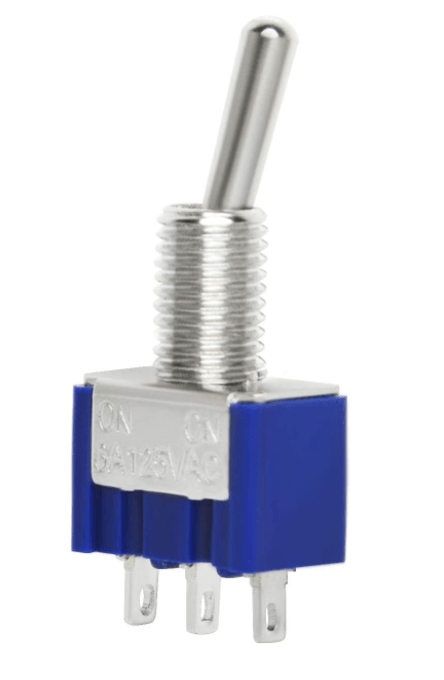
This leads into the second topic, how to power on and off the Arduino so that it doesn’t constantly use the battery. The first solution was to shut the on-board modem off and put the Arduino to sleep, however that doesn’t completely shut off the power consumption. What if we only want to take a single reading and then not use the device for a month or more? That’s why the second solution cuts off the electrical current by means of a simple interrupter switch, which I’ll call a toggle switch [1]. H2OSupport will have a single component soldered to two wires, in series with the 9V battery. This will enable a user to turn the device on, take a reading, then turn it off once it has completed the task. If the device is turned off before the reading has finished, it will simply not be uploaded to Soracom Harvest. I still have to decide if the data should be stored locally, in which case I would need an external memory component.
Finally, I’ve just recently managed to get a replacement for the first MKR 1500 which wasn’t working anymore. It may not have been purely a design fault, but the board did already have a LED that was out and the modem wasn’t very responsive. The new MKR 1500 I received is so much quicker, it responds faster to serial commands and connects to a network much more reliably.
Sources
[1] Amazon, “Gikfun MTS102 2 Position 3 Pins Mini Toggle Switch for Arduino (Pack of 10pcs) EK2021”. [Online]. Available: https://www.amazon.ca/gp/product/B01BWL7Z44/ref=ppx_yo_dt_b_asin_title_o00_s01?ie=UTF8&psc=1

 H2OSupport