
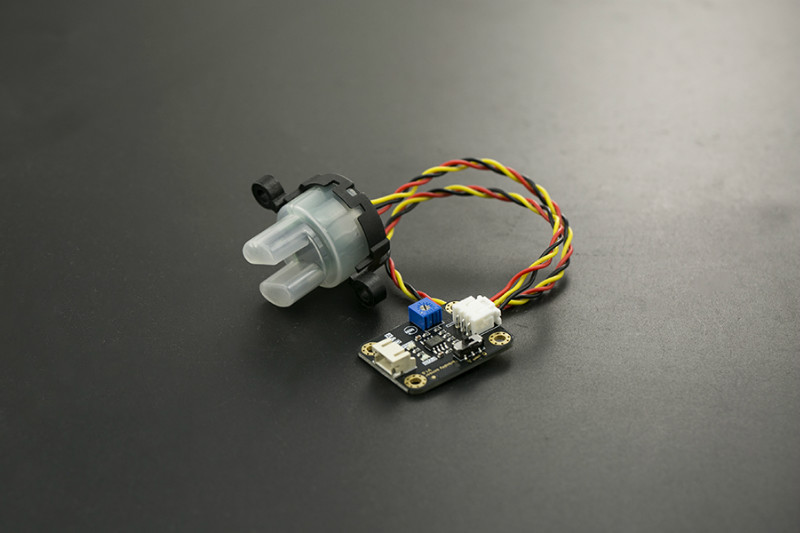
Another useful property of a liquid for water monitoring is turbidity.
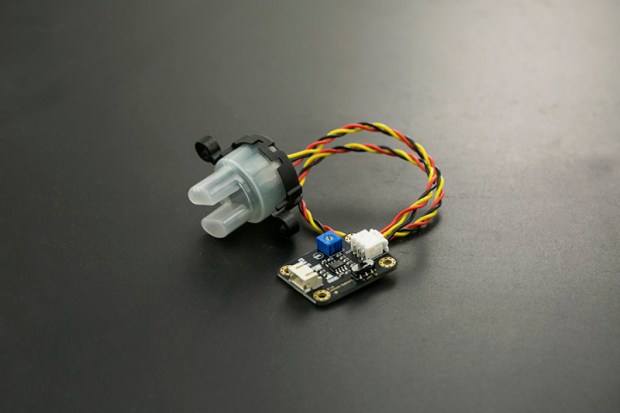
The analog turbidity sensor can determine the quality of water by sending and retrieving a beam of light. This beam will be scattered in multiple directions by suspended particles in the water. These particles are referred to as total suspended solids (TSS) [1]. You can think of it as an opaqueness sensor, if the water is opaque the sensor will return a certain voltage, and a different voltage if the water is more translucent. Unlike most of the other sensors, this one does not need to be calibrated before usage.
The number of TSS in a body of water usually reflects how dirty or contaminated it is. For example, if we could get our hands on completely pure water, which is very clear, it would have no turbidity. In a body of water, turbidity may increase from soil erosion, presence of algae or sediment coming from the water bed [2].
Sources
[1] DFRobot, “Gravity: Analog Turbidity Sensor For Arduino”, DFRRobot. [Online]. Available: https://www.dfrobot.com/product-1394.html
[2] Michigan Tech, “Turbidity”, Michigan Environmental Education Curriculum
Stream Monitoring. [Online]. Available: http://techalive.mtu.edu/meec/module05/Turbidity.htm#:~:text=Low%20turbidity%20means%20that%20there,up%20from%20the%20stream%20bed

 H2OSupport