
Arduino
To start working on the project, it would be practical to have an Arduino board. Arduino sells multiple types of boards, which can all complete the same basic tasks, such as sending signals to light up small LEDs or retrieving data from analog sensors. However, all their boards are different, from some boards being almost identical, to some boards being a close polar opposite.
Internet of Things (IoT)
As this project will be, hopefully, connecting the H2OSupport device with mobile cellular technology, the type of board that could fulfill such a task easily would be the Internet of Things (IoT) microcontrollers. IoT is a virtual network that wants to interconnect everyday objects in order to retrieve or send data. A classic example would be setting up microchips in every stoplight in a city and being able to control all these stoplights from a single app.
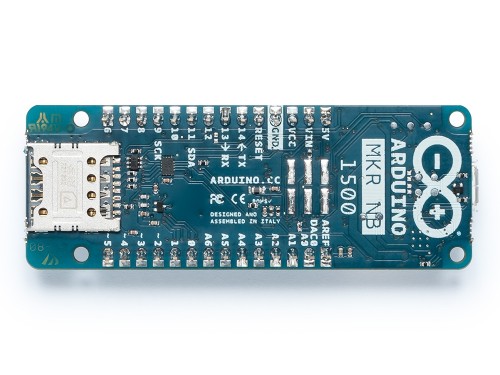
After a few hours of comparing the IoT microcontrollers, I’ve found that the Arduino MKR NB 1500 [1] would best fit the needs for this project. This microcontroller can accomodate the use of Narrowband (NB) technology, usually noted NB-IoT. NB-IoT is perfect for H2OSupport, because it can operate without an internet connection, in a remote location for example. In addition, the board features a full lithium powered battery support. These two factors mean that H2OSupport will be able to be used just about anywhere, perfect for rural locations or far away lakes and rivers. MKR just means that it is compatible with classic Grove components, which I will cover later on.
The board costs around 77$, which will definitely be going into the budget for this project.
Sources
[1] Arduino, “Arduino MKR NB 1500”, Arduino Store. [Online]. Available: https://store.arduino.cc/usa/arduino-mkr-nb-1500

 H2OSupport